Fed in a Hotel Room #1: The Minimal Food Kit for Your First Field Assignment
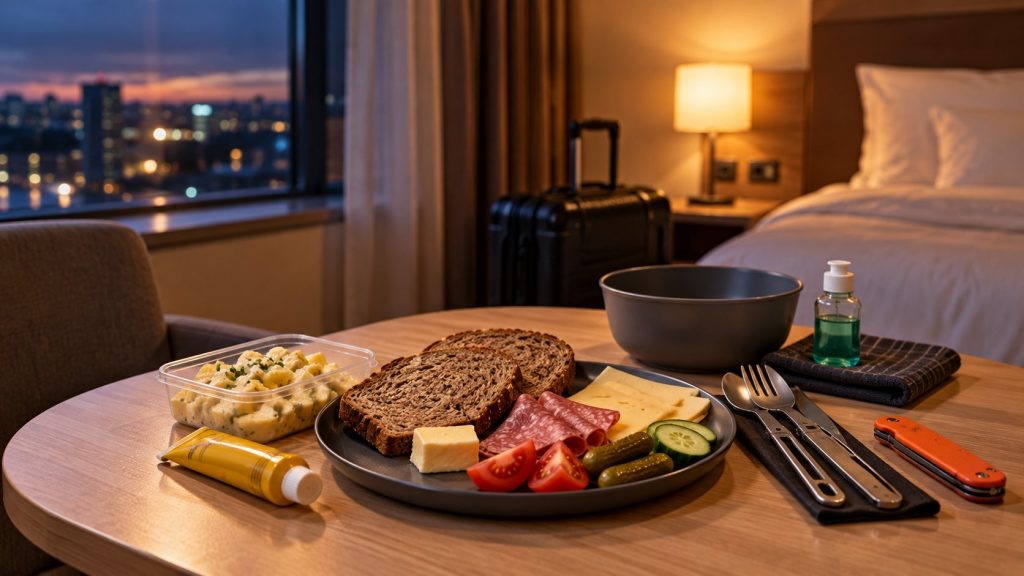
After work, I stopped at a supermarket and planned a perfectly ordinary dinner: sliced bread, butter, cold cuts, cheese, pickles and a tomato.
Then I remembered where I was going to eat it: a hotel room.
The room had a coffee maker, two ceramic mugs and two teaspoons. That would probably have been enough to spread butter if I got creative. It was not going to cut a tomato, slice cheese or deal with a cucumber. I had no proper knife and no cutlery with me.
So I changed the plan. I bought a pack of sausages, a tube of mustard and a small tray of potato salad. The sausages came straight from the pack, the mustard straight from the tube, and the potato salad could be eaten with the hotel teaspoon.
It worked. It also made something obvious: you do not need a full kitchen to feed yourself in a hotel. You first need the boring basics.
Start with the cutlery drawer at home
If you leave for your first assignment tomorrow, do not wait for a perfect travel setup. Take a regular fork, a tablespoon and a decent knife from home. Add a bowl or food container you already own, plus a sturdy plastic plate. That is enough to start.
That was my first setup. Nothing matched, and the pieces rolled around loose in my suitcase. It still did the job. Only after several trips did I start making it more compact.
If you fly, put the real cutting knife in checked baggage and protect the blade properly. Do not treat a knife as carry-on gear. Airport screening rules, airlines, transit airports and local laws all matter. The same caution applies to plastic cutlery: it may be fine at one security checkpoint and rejected at another.
A tiny emergency set for the backpack
I keep one individually wrapped plastic cutlery set in my daypack. In the US, you get these all the time with takeout, delivery, restaurants and fast food. Usually there is a plastic knife, fork, spoon and a napkin inside. Some packs also include salt and pepper.
It is a backup for the moment when you pick up something at a supermarket, have a salad bowl or takeout in front of you, and there is no cutlery anywhere. That is all it needs to be.
One set stays in my backpack. A second stays in the suitcase. If I use one, I can replace it. If it was only used for something simple, I wipe it down or wash it and use it again during the trip.
I have never had a problem taking these plastic sets on a flight. That is personal experience, not a promise that every airport will allow them. In the US, the TSA specifically lists plastic cutlery as an exception to its carry-on knife restriction. EU departures work under a different framework, and individual airports or airlines may make a stricter call. Check before you travel. If you are unsure, leave the plastic knife out. The fork and spoon solve most of the problem anyway.
What is in my suitcase now
After a few trips, I replaced the loose household cutlery with two additions: a classic German Bundeswehr folding cutlery set and a separate Victorinox knife.
The Bundeswehr set still travels with me. The fork is sharp enough for pickles, cocktail onions or fruit from a jar. The spoon is slightly larger than many regular tablespoons, which I like for yogurt, cereal or potato salad. Most importantly, the pieces slide together into one compact unit instead of ending up in three different corners of the suitcase.
The small can opener falls into the category of things I rarely need but am glad to have when I do.
The knife built into that set is the weak point for me. It is fine for butter, Nutella or another spread. For tomatoes, cucumbers, cold cuts or cheese, it feels more like a blunt piece of metal than a knife.
That is why I also carry a Victorinox Swiss Classic Picnic Knife with a serrated edge. The blade folds safely into the handle. Victorinox lists it at 42 grams with an 11 cm blade. It handles bread rolls, bread, cold cuts, cheese, fruit, tomatoes and cucumbers, and it still spreads butter on a slice of bread. I do not need anything more elaborate for this job.
A bowl and a plate are enough
I bought my plastic bowl at Walmart during an assignment in the US. The reason was simple: I was standing in front of a huge cereal aisle, wanted cereal with milk and needed a proper bowl in the hotel room.
It stayed in my kit because it turned out to be useful for much more than cereal. Skyr with muesli, yogurt, fruit, potato salad, a prepared salad or food from a salad bar all work without any hassle. When the room has a refrigerator and I am staying longer, I may buy a larger tub of yogurt or milk for several days.
Today, I would add a sturdy plastic plate with a low rim. It does not need to pretend to be a special cutting board. For what I do in a hotel room, a stable, smooth surface is enough: spread bread, cut a tomato or cucumber, prepare cheese and cold cuts, then eat.
Plastic makes sense here. It is light, it survives luggage better than porcelain or glass, and I do not want to open my suitcase after a flight and find broken dishes inside. Microwave-safe and dishwasher-safe are useful extras if the product has them. They are not requirements for a first kit.
I am still looking for a really good nested solution that combines a bowl, plate, storage and a small cutting surface. The Light My Fire Outdoor MealKit 2.0 is an interesting researched option, but it is a larger multi-piece system and not something I have used myself. It is not necessary for your first assignment.
Supermarket building blocks, not hotel recipes
I do not work from a fixed meal plan on the road. After work, I walk through the supermarket, see what is available and decide based on appetite, how long I am staying and what the hotel room offers.
The rule is simple. The food has to be ready to eat, fully cooked and fine cold, or manageable with a bowl, plate, knife, fork and spoon.
Sometimes that means a regular German-style cold supper: bread or rolls, butter, salami, cold cuts, cheese, tomato, cucumber and a few pickles. In Germany, I like buying ham or sliced meat from the counter, or picking up rolls from a bakery or supermarket bake shop. Some nights it is simply a bread roll with jam or Nutella.
Potato salad with sausages and mustard is another reliable option. It is especially useful on the first night because it can be eaten straight from the packaging if needed.
Other combinations that end up in my room regularly include Harz cheese with canned tuna, tomatoes and cucumber; Skyr or yogurt with muesli; cereal with milk; meatballs with coleslaw; and prepared salads. If a supermarket has a salad bar, I will often build a salad there and take it back to the hotel.
I do not think of these as hotel recipes. They are normal supermarket foods that work in a hotel room.
I have also found the limit of the cold-food approach. Canned soup can be eaten cold. I have tried it. It works technically, but it is not enjoyable. That is the point where a kettle, microwave or later a small cooking device starts earning its space in the suitcase. That is a subject for later posts.
Cleaning without packing a dishwashing station
I keep a small bottle of dish soap in my toiletry bag. That is all I bring specifically for cleaning.
In a regular hotel room, I wash the bowl, plate, knife and cutlery in the bathroom sink: water, a drop of dish soap, clean with my hand or a hotel washcloth, rinse and dry with a hotel towel. That covers normal day-to-day use.
US extended-stay hotels sometimes have a pantry or a small real kitchen, occasionally even a dishwasher. Then I use what is there. At home, suitable items go through the dishwasher from time to time as well.
The minimum I would pack for a first assignment
If you have five minutes before you leave, pack this:
- a fork
- a tablespoon
- a usable knife in checked baggage
- a plastic bowl
- a sturdy plastic plate
- a small bottle of dish soap
That is enough to move beyond fast food or a restaurant every night. Once you know what you actually miss, you can decide whether compact cutlery, a better bowl, an insulated mug or a larger system deserves room in your suitcase.
You will not cook like you do at home. You can still put together a normal dinner after a long day without much effort.
Flight-travel sources and notes
- Victorinox: Swiss Classic Picnic Knife, 11 cm
- German Federal Police: Prohibited articles when flying
- TSA: Knives – What Can I Bring?
- IATA: Passenger baggage rules