Travel adapters for field service: My power setup for hotels, rental cars, and job sites
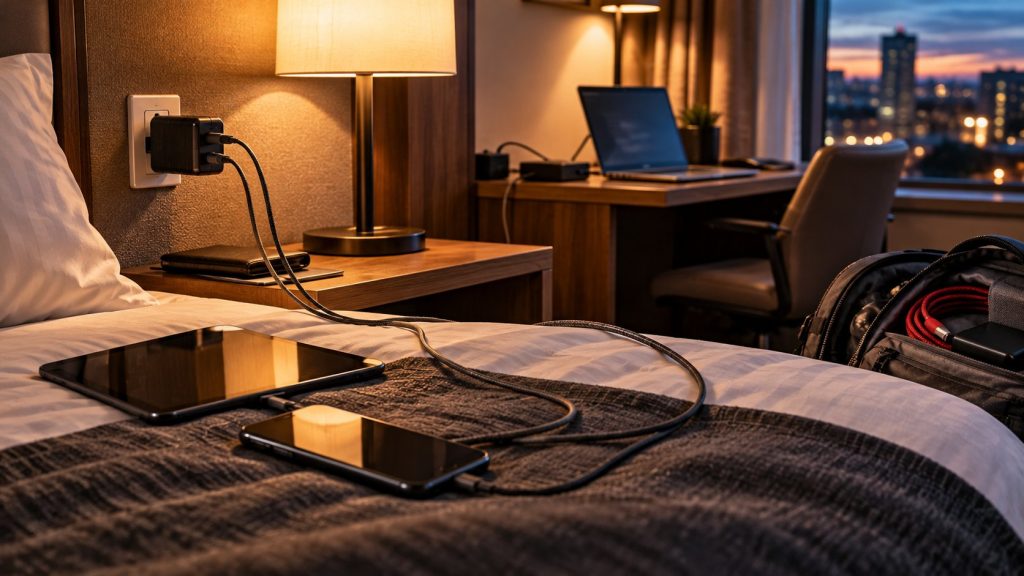
Some time in the middle of the night, a small pull on the charging cable was enough. Then came the thud on the bedside table, or sometimes straight onto the floor. I was awake after that.
It was not caused by a broken hotel socket or an unusual power system. At the time, I had plugged a PowerCube into a universal travel adapter. The cube itself had made sense: more outlets, USB ports, and fewer individual chargers. Add the travel adapter in front of it, though, and it became a long, heavy arrangement sticking well out of the wall. Pull the cable, and eventually the whole thing came down.
My current travel power setup grew out of annoyances like that. I am not trying to carry the highest wattage or the longest list of accessories. I want a few items that let me work reliably in a hotel, rental car, and customer environment.
It started with too few hotel sockets
Eight or ten years ago, nearly every device had its own little power brick. Phone, tablet, toothbrush, and other small electronics all needed separate plugs. The socket at the desk was usually taken by the laptop. Near the bed, there was often only one outlet left. That was the real bottleneck.
The PowerCube solved it well at first. It sat by the bed and turned one socket into several. Individual chargers could plug in around its sides, with USB cables connected directly to the cube. For European hotels, it was a useful solution.
It only became awkward on international trips. The additional travel adapter created more distance between the wall and the cube. That put a fair amount of weight on a hotel socket that was not always particularly tight to begin with. It still worked, but it was too bulky for daily travel. I did not replace it because it lacked charging power. I replaced it because it woke me up more than once at night.
Fewer chargers instead of a larger pile
USB-C changed a lot. I gradually removed the small individual chargers and split two universal travel chargers between fixed places. One lives in my checked suitcase; the other stays in my laptop backpack. The gear is ready where I need it without being packed and unpacked every evening.
The suitcase holds a black Momax 1-World GaN 70W. It has three USB-C and two USB-A ports, and it becomes my charging station by the hotel bed. The backpack carries a Momax 1-World GaN 100W with two USB-C and two USB-A ports. That one comes to the customer site or job site with me.
Both also have a universal AC receptacle. I need that much less often than I used to, but the need has not disappeared entirely. My Oral-B iO9 is one reason: its current magnetic charging puck still uses a conventional mains plug. I am looking for a genuinely suitable USB-C option, but I have not bought or tested one yet.
Wattage alone does not decide how well this works day to day. The 100W Momax has powered my Dell Precision reliably at customer sites because the laptop is not under continuous full load and is normally well charged before I leave the hotel. That is my experience with my own work pattern. It does not mean 100W will suit every Precision, docking station, or sustained heavy workload.
In the hotel: a clean charging spot by the bed and a desk for work
Once I check in, the 70W Momax goes beside the bed. I connect a roughly three-metre, dark grey Anker Bio-Braided USB-C cable. The cable is rated for up to 240W, but the Momax does not suddenly put out 240W because of that. The cable rating describes what the cable can handle, not what the charger supplies.
The three metres are not a tech gimmick. Hotel sockets often sit exactly where you do not need them. With the long cable, I can use my iPhone or iPad in bed even when the outlet is behind a bedside table or on the wrong side of the bed.
My routine is not particularly exciting. The iPad might still be playing YouTube or TV in the evening. When I go to sleep, the cable moves to the iPhone. The phone gets priority for the next morning. When the alarm goes off, I switch the cable back to the iPad. It charges while I shower, have breakfast, and get ready for the day. If the iPad is especially low and I do not need it at the customer site, it stays in the hotel. I do not need a second charger for that.
The hotel desk is separate. My Dell Precision's original 130W power supply stays there from setup until departure. That arrangement goes back to an older 17-inch Precision and its large 240W brick. Carrying that in the backpack was simply annoying. The current original charger is smaller, but the habit still works: it is fine in the suitcase and at the desk, and it does not need to come along in the backpack.
In the backpack: a separate set for the job site
The 100W Momax and a red Anker USB-C cable normally stay in my laptop backpack. The red cable is three metres long and rated for up to 100W. Its most useful feature for me is the colour.
The grey cable stays in the hotel and by the bed. The red one can pick up dust, dirt, or residue at a customer site. I do not want a cable that has been lying around on a job site ending up between my pillows and iPad later that evening. There is nothing sophisticated about it, just a separation that has worked for me.
I also keep a DeWalt DCB094K in the backpack. With a compatible DeWalt 20V MAX or FLEXVOLT battery attached, it can supply USB power to devices. It can also charge compatible batteries through USB-C. For me, it is a small extra option when a tool battery is travelling anyway. It is not a general power solution, and it does not make every USB device an appropriate use case.
I do not currently carry a conventional power bank. My devices are normally charged, rental cars usually provide a USB port, and in an exceptional case the iPad can give the iPhone some power. The DeWalt adapter is another reserve when compatible batteries are with me. I do not buy a power bank simply because every travel checklist says I should.
For the rental car, a USB-C cable and a small USB-A-to-USB-C adapter are usually enough. I stopped carrying a separate 12V car charger some time ago. Every newer rental car I have driven has had a usable USB port so far. That is my experience, not a promise for every rental vehicle.
An adapter changes the plug, not the voltage
A travel adapter normally changes the plug shape, not the voltage. Before a trip, I check the input rating on the relevant power supply and use an adapter directly at the wall socket. Chaining several adapters together is no longer part of my setup.
That is also the point of the old PowerCube story. It was the practical reason I changed my system, not an arrangement anyone should copy. For devices with a conventional mains plug, I check the manufacturer's information before travelling. Oral-B also advises travellers to check the charger voltage and the destination voltage separately.
If I ever carry a conventional power bank again, I will check the airline's rules before flying. IATA lists power banks up to 100Wh in carry-on baggage, not checked baggage. For now, that is only background information because I do not have one in either suitcase or backpack.
What may change next
I am happy with both Momax chargers. They have been reliable and removed a lot of individual chargers from my luggage. Because they include an AC receptacle, they are relatively thick.
One possible next step is the Anker Universal Charger, 100W GaN USB-C Travel Fast Charging. It has international plug functionality but no additional AC receptacle. That would fit my increasingly USB-C-based setup. I have not bought it, and I certainly have not tested it on an assignment. Whether it really works better in my backpack is something I can only judge once I have it in my hand.
I am not looking for a perfect universal adapter. I want two separate and manageable charging sets: one clean set in the hotel and one ready-to-work set in the backpack. Everything else only stays if it has a real job while I am travelling.
Sources and notes
- USB-IF: USB Power Delivery
- USB-IF: Cables and connectors
- Momax: 1-World 100W GaN Travel Adapter (UA10)
- DeWalt: DCB094K USB Charging Kit
- Oral-B: Using an electric toothbrush charger abroad
- IATA: Passengers travelling with lithium batteries, 2026
This article describes personal experience from international field-service assignments. Check manufacturer instructions and airline rules before your own trip.