Packing Cubes and Case Systems for Field Service: How I Keep Everything Where It Belongs
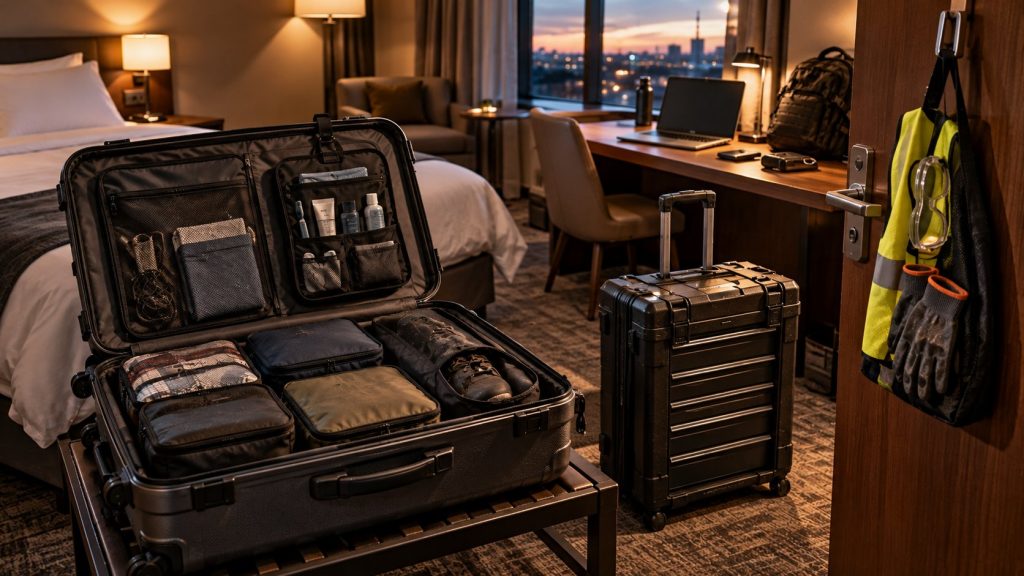
There is one thing I do almost automatically when I arrive at a hotel after a long travel day. I open the big suitcase, take out my PPE bag, and hang it on the inside door handle.
It is not there because it looks tidy. It is there because I have to walk past it the following morning.
That sums up how I organize travel gear. I want things to show up at the moment I need them, without rebuilding the whole system before every trip. After enough assignments, you learn how easily a toothbrush stays at home by the sink, or one small item disappears somewhere between clothes and cables. My setup was never designed in one sitting. It grew out of forgotten essentials, dirty work shoes next to clean clothes, and too many loose bits rolling around in a suitcase.
Three bags, three clear jobs
For a typical international assignment, I normally travel with three main pieces of luggage:
- a Samsonite S’Cure Spinner 81/30 as my large checked suitcase,
- a GT Line All in One tool case, also checked,
- and a grey Wenger laptop backpack as my carry-on.
The backpack is my laptop and electronics module. I have covered its layout and contents in a separate article about my field-service laptop backpack, so there is no point repeating that whole story here. In this system, its role is simple: my laptop and the things that need to stay with me on the flight do not go in the large suitcase.
The tool case has a different job. It belongs at the customer site, not in my hotel room. Once I have picked up the rental car, all three pieces go in the vehicle. At hotel check-in, I usually take only the suitcase and backpack upstairs. The GT Line stays in the car because I only need it at the customer site, and I do not see a reason to drag it through the hotel every evening.
It sounds obvious, but separating those roles saves a surprising amount of pointless carrying.
The large suitcase is not a travel wardrobe
I do not empty the big suitcase completely once I arrive. I treat it more like mobile storage with a few modules that come out when needed.
The clothing side holds Amazon Basics packing cubes in different sizes. I combined cubes from several sets and only use the ones that work for me. One large green cube is for work clothes: two or three pairs of bib overalls, a light work jacket, and around four work tops. Depending on the customer, that may mean presentable shirts, high-visibility shirts, or light long-sleeve tops where covering your skin is required.
The medium cube is for leisure clothes. Two small cubes have permanent roles: one for underwear, one for socks. Each has a target count of 14. That is not a rule for anyone else. It is simply my buffer. Many assignments are scheduled for one week, but if one turns into two, I do not want an urgent search for a laundry room to be the first problem I have to solve.
I do not use packing cubes to compress everything as hard as possible. Shirts in particular can come out looking as if they spent the flight in a vise. I use them for separation. Work clothes stay together, off-duty clothes stay together, and I can see what is missing without digging through the whole case.
Keeping dirt separate matters more than looking organized
The first real step toward my current system was not about organization. I simply stopped wanting work shoes, oil residue, or dust from a production site near clean clothes.
My shoes now go into a separate bag. Before that, I used ordinary supermarket carrier bags. They were not elegant, but they did the job very well. That is a principle that runs through this whole setup: not every problem needs a specialist organizer. If a cloth bag or sturdy plastic bag separates things cleanly, it is often enough.
The same goes for PPE. My helmet, safety glasses, gloves, high-visibility vest, hearing protection, and knee pads live in a plain cloth shopping bag. It does not need to look technical. It just keeps the PPE together while it moves between the suitcase, rental car, and hotel.
On the first evening, that bag goes on the inside hotel-room door handle. I cannot really miss it in the morning. After the first day with the customer, it usually moves to the back seat of the rental car and stays there for the rest of the assignment.
What comes out in the hotel, and what stays packed
I do not build a second household in a hotel room. I unpack only what I will genuinely use there.
My MFH BW Washbag, flecktarn, item no. 30481V is one of those items. It hangs up, has separate compartments, and gives small things a fixed place. In the bathroom it sits near the sink, where toothpaste, medication, toiletries, and the usual little items are easy to reach.
A wash bag with one large compartment would not work for me. That is where small stuff disappears, usually when you are half awake and looking for it. This is one of the items where I would not cut corners. I have even considered buying a spare while this model is still available.
The heavy original laptop power brick also does not go back into my backpack every morning. It gets set up on the hotel desk once and stays there until departure. I use a separate power and charging setup at the customer site. That keeps weight off my back and stops the charger from moving constantly between bed, backpack, and desk.
A few devices still live in their original manufacturer cases: my Oral-B iO 9, a Philips OneBlade, and a small USB-C soldering iron. It works, but it is not my favorite part of the setup. Several small cases quickly become several loose items again. Combining them in one pouch would be my next sensible improvement. The iO 9 travel charger is also bulkier than I would like. A small USB-C magnetic charging puck that could stay in the wash bag would be far better.
Small items need a fixed home
Not everything in a suitcase needs its own pouch. Small items are different.
At the bottom of my case, I use a Wera tool and organizer module. It keeps important travel and work documents, cards, travel cutlery, small service items, and the things I use while preparing work clothes in one place. I am still verifying the exact Wera combination before I name it precisely. The brand is not really the point anyway. The point is that small items do not travel loose around the suitcase.
Before this system, that was a recurring problem. Things ended up between clothes, cables, and shoes. They always turned up eventually, just rarely when I needed them.
I do not repack the suitcase. I reset it.
The biggest change came when I stopped emptying the suitcase completely after every trip.
For me, a travel suitcase is ready again when I can live normally at home without taking anything back out of it. Then it is ready for the next assignment.
The reset is straightforward:
- take out and wash dirty clothes,
- bring the packing cubes back to their target count,
- refill or replace travel-size consumables,
- clean and inspect PPE, replacing worn items right away,
- put everything back in its assigned place.
For inexpensive consumables, I deliberately buy duplicates. Moving toothpaste, deodorant, or skincare products between the bathroom and the suitcase may look economical, but sooner or later it costs time and creates a forgotten item. Full-size products stay at home. The travel containers get refilled. That has proved more reliable for me than rebuilding a packing list every time.
My short reset checklist
Before closing the suitcase again, I check five things:
- Clothes: Are underwear, socks, and work clothes back at their target count?
- Consumables: Are toothpaste, deodorant, toiletries, and other travel containers topped up?
- PPE: Is it clean, complete, and free from worn-out items?
- Small items: Are documents, cards, and service essentials back in their module?
- Separation: Are shoes and used clothes kept away from clean gear?
What I keep from the system
My setup is not a perfect system, and it is not a shopping list that will suit every field service tech. It is the outcome of many small corrections.
Packing cubes turned loose clothes into defined modules. The bag on the door keeps my PPE from being left in the hotel. The organizer module keeps small items under control. And a suitcase that stays packed means I do not start from zero before the next trip.
My own rule is fairly plain: every container needs a job. Things without one usually do not need a specialist bag. Things that are easy to lose need a permanent home.