My first overseas assignment: what really belonged in my tool case
My first overseas assignment: what really belonged in my tool case
In 2019, I went abroad for a longer assignment for the first time: three weeks in Ulsan, South Korea, for a process-industry customer. Until then, I had only flown within Germany. I met an experienced colleague in Prague and we continued the journey together. I was looking forward to the job, but one thing worried me more than anything else: baggage weight.
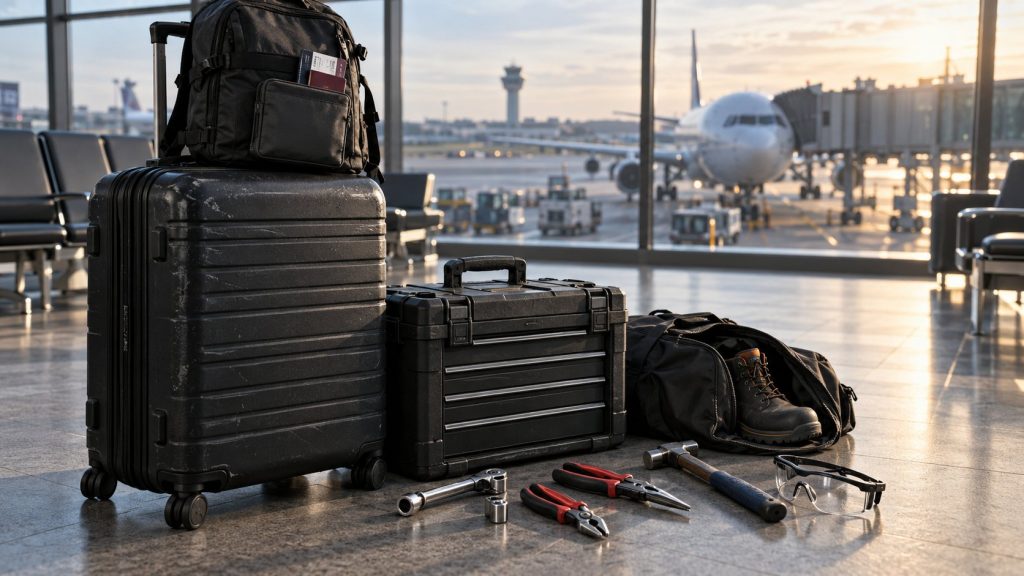
These days I travel with a laptop backpack, a suitcase and a tool case that sits close to the 32 kg limit. Back then, I was nowhere near that setup. I packed a suitcase weighing about 23 kg and put the tools in there as well: a small Stanley organiser, a few screwdrivers, a ratchet and some sockets. That was it.
It was hardly a carefully developed system. I simply did not know what a job like this really feels like. I picked what seemed sensible based on my previous jobs.
Three weeks in Ulsan, where theory stopped helping
At the customer’s site, we were completing the installation of three bagging machines with valvomats. We still had work to do on seals for the inlet flaps, the final floor anchors for bag conveying, and a new load-cell cable at the FIBC station. Then came commissioning and operator training.
On paper, I knew the scope. On site, you learn quickly that a list on your phone is not the same thing as experience.
One job involved removing rotary flaps. There were twelve bolts with a 30 mm wrench size, and I did not have the socket I needed. Buying one was easy enough in the end. We told our driver what we were looking for, he dropped us at a tool shop, and we found the right socket.
Still, those moments stay with you. Not because they are impossible to solve, but because a small gap can suddenly set the pace for the day. The local team had its own work to do and was equipped more for installation than maintenance. I did not want hunting for basic tools to become part of every job.
The missing items were not all dramatic either. More pliers and a hammer would have made a real difference. Holding a part, gripping it or getting it into position becomes awkward when you do not have the right tool. I got through it. It was not comfortable.
What I took away from that first long flight
The lesson was not that I needed to take two of everything next time. That is an easy trap before a first overseas assignment. You can quickly end up buying tools, bags and contingency gear for every imaginable scenario.
Today, I travel prepared with a system. I do not want to drag three or four extra cases through an airport. A laptop backpack, one suitcase and one tool case cover most jobs. The tool case stays packed as my baseline. After the project manager’s briefing, I add only what makes sense for that particular installation: perhaps a cross-line laser, cordless drill, impact wrench or alignment punch.
Nearly any tool could be useful one day. What matters is whether it fits the machine, the job and the work I actually do.
If I had to point a colleague in the right direction for a first trip, I would not hand them a list of a hundred items. A solid small setup of spanners, a pliers wrench, water-pump pliers, a hammer, side cutters, plus a ratchet, bits and common sockets already covers a lot. For my 3/8-inch drive, 10, 13, 17 and 19 mm are the sizes I reach for most. An adapter to 1/2 inch gives me some flexibility for larger sizes. Everything beyond that depends on the equipment and on the jobs that come up repeatedly.
Organisation starts before the tool case
Over the years, those first trips turned into a system. Not because I enjoy writing packing lists, but because having a fixed place for everything clears my head.
My backpack holds what I need while travelling: laptop, tablet, adapters, cables, documents and the things that need to be close at hand in an airport. On flying days, my passport, cards and travel documents go into a chest pouch. In a rental car, a fixed place for my phone and the CarPlay cable is more useful than any grand travel hack. I get in, have navigation and my usual setup straight away, and I am not digging through the glove box first.
In the suitcase, I separate work clothes, casual clothes, PPE, toiletries and dirty laundry in packing bags. My safety boots have their own bag. That is not a gimmick. Everything sits close together in a suitcase, and I do not want boots contaminating clean clothes or the rest of my equipment.
I have also learned not to pack clothes “just in case.” I take enough for about two weeks and have laundry done after that. Extra casual clothing mostly takes up space. What I travel in, plus a spare pair of trousers and a spare shirt, is normally enough.
Do not try to solve every problem at once
An overseas assignment always has an unpredictable side, especially the first one. A tool may be missing, a part may not fit, or the customer’s processes may be different from what you expected. That comes with the job.
What changed after Ulsan was this: I do not rely on somehow finding everything once I arrive. I prepare better, I know my baseline setup, and I add to it with a reason. At the same time, I do not turn every possible scenario into another checked case.
So my advice for a first longer assignment is not a perfect tool case. Build a system that fits your work and give every item a fixed place. If an entire module is missing, you spot it immediately. A single toothbrush can be forgotten. A whole toiletry bag usually cannot.
With cordless tools, check the airline rules before you travel. IATA advises travellers to keep battery-powered devices and spare batteries in hand baggage, protect loose batteries against short circuiting, and ask the airline in advance about larger batteries over 100 Wh. At check-in, it is too late to sort that out.
My first overseas assignment did not give me a perfect packing list. It taught me what matters: know what you need, know what you have packed, and turn every trip into one more piece of routine.
Note: Airline requirements can differ by carrier and route. For batteries and other dangerous-goods questions, the rules of the airline you are flying with always apply.